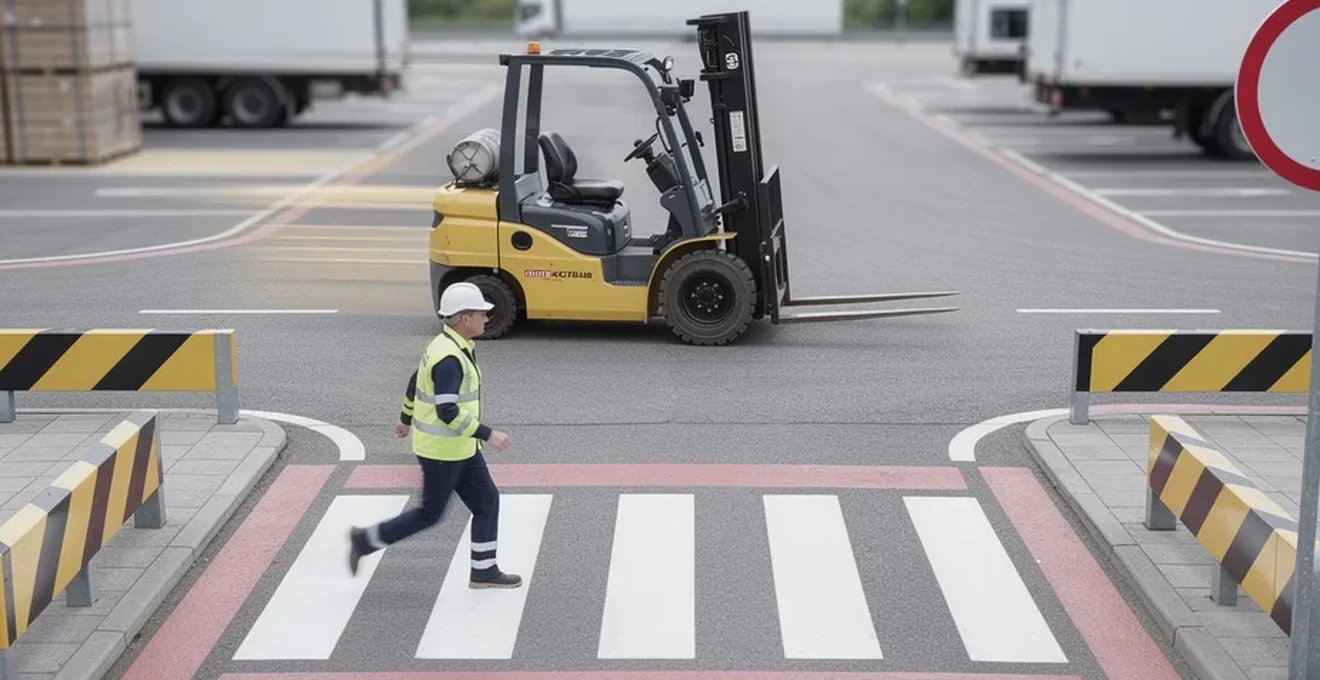
Vehicle speed is one of the most controllable risk factors on any commercial site, yet it remains one of the most persistent causes of workplace injury and death. Forklifts, HGVs, yard shunters and other vehicles moving around warehouses, distribution centres and industrial yards create a constant risk of collision with pedestrians, structures or other vehicles. Managing that speed is not simply a matter of good practice: it is central to protecting workers, avoiding regulatory breaches, and keeping a business operating without costly disruption. This article looks at why speed matters so much on commercial premises, what the regulatory expectations are, and which engineering, layout and behavioural measures actually reduce risk on the ground.
Vehicle speed as a critical risk factor on commercial sites
Speed determines two separate but related things in any workplace vehicle incident: whether the driver can stop in time to avoid a collision, and how severe the outcome is if they cannot. Both factors make speed management one of the most effective levers available to reduce vehicle-related harm on commercial sites.
Kinetic energy and impact severity at increasing velocities
The faster a vehicle is travelling, the greater the force involved in any impact, and the more severe the resulting injury is likely to be. This relationship is not linear — small increases in speed produce disproportionately large increases in risk. Research into pedestrian impacts shows that the risk of a pedestrian dying in a collision with a car increases slowly up to an impact speed of around 30mph, but above that threshold the risk of death increases rapidly. On commercial sites, where pedestrians frequently share space with reversing lorries, forklifts and yard vehicles at close quarters, even modest reductions in vehicle speed can materially reduce the chance of a fatal or serious outcome.
Stopping distance calculations for forklifts, HGVs and yard vehicles
Stopping distance is a function of reaction time plus braking distance, and both worsen as speed increases. A vehicle travelling at 30mph covers around 44 feet — roughly three car lengths — every second before the driver even begins to brake. Increasing speed from 30mph to just 35mph adds more than two car lengths to the total stopping distance in good conditions. On a commercial site, where vehicles frequently operate in confined yards, around blind corners, or in close proximity to pedestrians and loading bays, this extra distance can be the difference between a near miss and a serious collision. Heavier vehicles such as HGVs, and load-carrying vehicles such as forklifts and reach trucks, are further affected by weight distribution and load stability, which can extend stopping distances beyond those of a typical car under the same conditions.
Blind spots and reduced reaction time in warehouse environments
Warehouse and yard environments are characterised by tight turning circles, racking that obstructs sightlines, and vehicles reversing into loading bays — all of which reduce the time available for drivers and pedestrians to react to one another. Higher speeds compound this problem by giving drivers even less time to identify a hazard, decide how to respond, and act safely. Many workplace vehicle injuries occur not on open roads but during reversing and slow-speed manoeuvres, or during loading, unloading, coupling and uncoupling activities, where the margin for error is already small.
HSE statistics on Vehicle-Related workplace fatalities in the UK
Vehicle movement remains a significant contributor to workplace deaths in Great Britain. In 2019/20, 20 people were killed after being struck by vehicles on business premises. The true scale of vehicle-related injury is likely higher still, since some incidents — such as falls from moving vehicles — are recorded under other categories like slips, trips and falls, rather than being separately identified as vehicle-related. This makes managing vehicle speed on commercial sites not just a health and safety obligation, but a genuine ethical duty and a commercial priority, given the potential for business interruption, reputational damage and litigation that follows a serious incident.
Regulatory framework governing speed management on commercial premises
Speed management on commercial sites sits within a broader legal duty to control workplace transport risks. Employers and site operators are expected to assess vehicle movement risks and put in place proportionate controls, including appropriate speed restrictions.
Health and safety at work etc. act 1974 compliance requirements
The overarching duty on employers to ensure, so far as is reasonably practicable, the health and safety of employees and others affected by their undertaking underpins all workplace transport safety measures, including speed control. This general duty requires employers to identify vehicle movement risks — including the risk posed by excessive speed — and to take reasonable steps to control them as part of a wider risk assessment process.
Workplace transport safety guidance (HSG136) from the HSE
Health and Safety Executive guidance on workplace transport safety sets out the practical steps site operators should take to manage vehicle movements, including the assessment of traffic routes, segregation of pedestrians and vehicles, and the setting of appropriate site speed limits. The underlying principle is the same as that applied to public roads: speed limits should reflect the actual conditions of the site, including road layout, visibility, and the presence of pedestrians, rather than being set arbitrarily.
Approved code of practice for Site-Specific speed limits
Where a site-specific speed limit is introduced, it should be based on a proper assessment of the site rather than applied as a blanket figure copied from elsewhere. Factors that should inform the choice of limit include the type and mix of vehicles using the site, the presence and volume of pedestrian traffic, the road layout and surface condition, and the areas where loading, unloading or reversing take place. As with public road speed limits, a limit that is not clearly justified by the conditions of the site is less likely to be respected or complied with, so the reasoning behind any restriction should be visible and understood by those working on site.
Engineering controls for enforcing speed restrictions
Signage and policy alone rarely achieve full compliance. Physical and technological controls play a central role in ensuring that speed limits translate into actual behaviour on site.
Speed bumps, rumble strips and chicanes in yard design
Physical traffic calming measures are among the most effective tools for controlling vehicle speed on commercial premises. Research indicates that vertical speed bumps can reduce accident rates by as much as 44%, and where accidents do still occur, the resulting lower speeds tend to produce less serious injuries. Speed bumps work because their physical presence forces drivers to slow down — typically to no more than 15mph when crossing a single hump — while a series of calming measures across a site can bring average speeds down to around 20mph.
Choosing the right specification matters. For most commercial sites, 50mm high domestic speed bumps or 75mm high commercial speed bumps are suitable, though the correct height and fixing method depends on the type and volume of vehicles using the site — a poorly fixed or undersized hump on a route used regularly by HGVs can be damaged or displaced, creating a new hazard rather than resolving the original one. Locations should be chosen following a full site risk assessment, covering not only main site roads but also secondary access roads, car parks, and areas where fleets or visiting lorries congregate. Any traffic calming feature must be clearly marked with hi-vis markings and signage, and positioned so that it does not obstruct access for emergency vehicles.
Telematics and GPS-Based speed monitoring systems
Fleet telematics and GPS-based monitoring allow site operators to track vehicle speed in real time and identify patterns of non-compliance across a site or a wider fleet. This data can highlight specific locations or routes where speeding is most common, informing decisions about where additional engineering controls, signage or driver intervention are needed.
Automatic speed limiters on forklifts and reach trucks
Many modern forklifts and reach trucks can be fitted with speed limiting technology that restricts maximum travel speed, particularly useful in areas of a warehouse where pedestrian activity is high or where visibility is reduced. This is a proactive engineering control that removes reliance on driver judgement alone, complementing rather than replacing wider site speed management measures.
CCTV and ANPR integration for traffic speed auditing
CCTV coverage of site roads and yards, in some cases integrated with automatic number plate recognition, allows operators to audit vehicle speeds after the event, review incidents, and identify recurring problem areas or drivers. This kind of monitoring supports both compliance enforcement and continuous improvement of site layout and traffic management arrangements.
Segregation of pedestrian and vehicle traffic routes
Controlling speed is most effective when combined with measures that reduce the opportunities for vehicles and pedestrians to come into conflict in the first place.
Designated walkways and physical barriers in distribution centres
Clearly marked pedestrian walkways, separated from vehicle routes by physical barriers, bollards or floor markings, reduce the likelihood of a pedestrian stepping into the path of a moving vehicle. In busy distribution centres, where forklifts and pedestrians frequently need to cross the same space, physical segregation — rather than reliance on speed control alone — is often the most reliable way to prevent contact.
One-way systems and traffic flow planning
Well-planned one-way systems reduce the number of points at which vehicles need to pass each other or reverse, simplifying driver decision-making and reducing the likelihood of low-speed manoeuvring incidents. Combined with clearly defined loading and unloading zones, a logical traffic flow plan reduces both the frequency and complexity of vehicle movements across a site, lowering overall risk exposure.
Driver behaviour and fleet management strategies
Engineering controls and site layout are most effective when supported by drivers who understand why speed limits exist and are motivated to comply with them.
Site induction training for vehicle operators
Every vehicle operator, whether an employee or a visiting HGV driver, should receive a site induction that covers speed limits, traffic routes, pedestrian zones and any site-specific hazards before they begin driving on site. This ensures that speed restrictions are understood in context, rather than simply presented as an arbitrary rule.
Toolbox talks on speed awareness for HGV drivers
Regular toolbox talks reinforce speed awareness among drivers who may otherwise become complacent about site rules through familiarity. These sessions provide an opportunity to remind drivers of common speed-related risk factors — such as the pressure to keep up with other traffic, feeling rushed, or failing to adjust for wet or slippery yard surfaces — and to review any recent near misses or incidents.
Disciplinary escalation procedures for speeding violations
A clear and consistently applied escalation procedure for speeding violations reinforces the seriousness with which a site treats speed management. Where monitoring systems such as telematics or CCTV identify repeated non-compliance, a structured response — ranging from retraining through to more serious disciplinary action — helps ensure that speed limits are respected rather than treated as optional.
Case studies of Speed-Related incidents on industrial sites
Reviewing real incidents helps translate abstract risk factors into concrete lessons for site management.
Amazon fulfilment centre forklift collision investigations
Forklift collisions in large fulfilment centres typically involve a combination of high pedestrian footfall, congested aisles and limited sightlines around racking. Investigations into these incidents commonly point to the same underlying factors highlighted elsewhere in this article: inadequate segregation between pedestrian and vehicle routes, and vehicle speeds that were not adjusted to reflect the level of activity in the area at the time.
Port of felixstowe yard traffic incident analysis
Ports and container yards present a distinct set of speed-related risks, given the scale of vehicle movements, the presence of heavy plant such as straddle carriers alongside HGVs, and the need for drivers to navigate complex, high-traffic areas. Incident analysis in these environments typically reinforces the importance of clearly defined traffic routes and speed restrictions that are matched to the specific vehicle mix and layout of the yard, rather than a single limit applied uniformly across very different areas of a site.
Lessons learned from RIDDOR-Reportable vehicle accidents
Incidents that meet the threshold for reporting under RIDDOR frequently share common contributory factors: excessive speed for the conditions, inadequate segregation of vehicles and pedestrians, and insufficient driver awareness of site-specific hazards. The consistent lesson from these cases is that speed management cannot be treated as a single measure in isolation — it works best as part of a combined approach involving site design, engineering controls, monitoring and ongoing driver engagement, mirroring the layered approach to speed management recommended for public roads.